
UNDERGROUND GALAMSEY MINING
Underground galamsey involves digging tunnels or shafts below the earth’s surface to extract gold-bearing ore using simple hand tools and locally improvised equipment.
Despite being illegal and often unsafe, it provides income for many rural miners in Ghana, particularly in gold-rich regions such as Tarkwa, Obuasi, Dunkwa-on-Offin, and Prestea. However, it also poses serious environmental, safety, and health challenges.
Types or Forms of Underground Galamsey Mining
-
Shaft Mining
Vertical or inclined shafts are manually dug to reach deep-seated gold veins.
-
Shafts are usually narrow and poorly supported with wooden logs or bamboo.
-
Ore is lifted to the surface using ropes, pulleys, or buckets.
-
-
Drift or Adit Mining
-
Horizontal tunnels (adits) are driven into hillsides or old pits to follow gold veins.
-
Ore is carried out manually in sacks or wheelbarrows.
-
Used in areas where gold-bearing rocks are exposed near the surface.

-
-
Stoping or Vein Mining
-
Involves extracting gold ore from narrow stopes or openings along quartz veins.
-
Miners work in confined spaces with minimal support, increasing the risk of collapse.
-
-
Abandoned Mine Re-entry
-
Galamsey miners enter old or abandoned shafts of large mining companies to extract leftover ore.
-
These tunnels often lack ventilation and are extremely dangerous.
-
Processing of Ore on the Surface
Once the gold-bearing ore is brought to the surface in sacks, it undergoes several rudimentary processing stages to extract the gold:
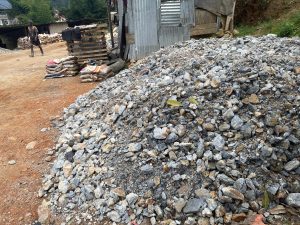
Underground rocks containing gold brought to the surface for milling
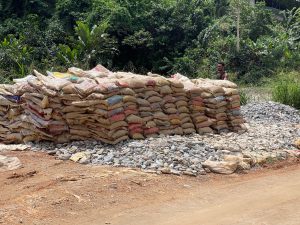
Underground rocks parked before milling
-
Crushing and Grinding
-
The ore is manually broken into smaller pieces using hammers.
-
It is then ground into fine powder using small diesel-powered milling machines known locally as “changfangs” or “grinding mills.”
-

Where underground rocks are been milled.
-
Washing and Concentration
-
The powdered ore is mixed with water and washed on wooden sluice boards, metal pans, or carpets.
-
Heavier particles containing gold settle at the bottom while lighter materials are washed away.
-
In some cases, mercury is added during this stage to trap fine gold particles.
-
-
Amalgamation (Mercury Use)
-
Mercury is mixed with the concentrate to form a gold; mercury amalgam.
-
This process is common but highly dangerous, as mercury is toxic and contaminates soil and water.
-
-
Burning or Smelting
-
The amalgam is heated in open pans or blowtorches to evaporate the mercury, leaving behind raw gold.
-
The gold obtained is usually impure and later sold to local dealers or smelters for refinement.
-
This surface processing method is simple but hazardous, exposing miners and the environment to mercury poisoning, dust inhalation, and water pollution.
Advantages of Underground Galamsey Mining
-
Employment and Livelihood Source
Provides jobs and income for thousands of people in rural communities where formal employment is scarce. -
Poverty Alleviation
Helps miners support their families, pay school fees, and meet basic needs. -
Utilization of Marginal Deposits
Makes use of small, low-grade ore deposits that large companies find uneconomical. -
Local Economic Activity
Encourages small-scale businesses such as food vending, equipment repair, and transportation around mining areas. -
Less Surface Disturbance (Compared to Open Pits)
Since operations occur underground, it occupies smaller surface areas than open-pit galamsey.
Disadvantages of Underground Galamsey Mining
-
Frequent Accidents and Fatalities
Tunnel collapses, suffocation, and flooding are common due to lack of proper support and ventilation. -
Severe Environmental Damage
Mercury use pollutes rivers and soils, while deforestation occurs from timbering for shaft support. -
Health Hazards
Miners suffer from respiratory problems, mercury poisoning, and poor sanitation underground. -
Illegal and Unregulated Activity
Leads to loss of government revenue and makes safety or environmental control nearly impossible. -
Destruction of Infrastructure
Tunneling under roads, farms, and buildings can cause land subsidence and structural damage. -
Conflict and Law Enforcement Challenges
Illegal operations often lead to clashes between miners, landowners, and security forces.
Underground galamsey mining remains a double-edged sword in Ghana’s mining sector. It provides income and employment to thousands of people but also causes severe safety, health, and environmental problems. The crude surface processing of ore using mercury further worsens pollution and health risks.
To address these issues, formalizing small-scale mining, introducing safer ore-processing technologies, and enforcing environmental laws are essential steps toward making the sector sustainable and beneficial for local communities.