
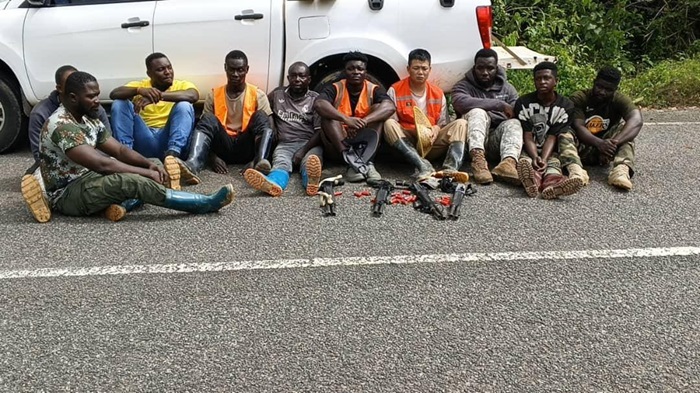
Ghana’s current doctrine in the fight against illegal mining has increasingly centred on arrests and crackdowns on labourers operating in pits and along river bodies such as the Ankobra. In practice, the strategy has become a confrontation with the most visible and most vulnerable actors in the chain, while leaving largely intact the deeper economic and structural forces that sustain galamsey.
This approach implicitly treats illegal mining primarily as a law-and-order issue. However, it is more accurately understood as an economic survival system shaped by rural neglect, inequality, and the sustained global profitability of gold. As long as these underlying conditions persist, enforcement actions focused narrowly on arresting laborers are unlikely to produce lasting change. They may generate periodic headlines, but operations often resume shortly thereafter. Now, look below at the factors promoting galamsey, and the solution Ghana has for them. Are we now suprised the fight has been going on for 13 years, without a single river or forest ever getting restored?
Factor: Systemic and normalized rural poverty.
State Solution: Arrest the labourers.
This will not solve the problem because poverty is not frightened by handcuffs. In many rural communities, illegal mining has become one of the few visible pathways out of hardship. Where generations have grown up without meaningful development, decent infrastructure, or economic opportunity, arrests only punish symptoms while preserving the conditions that produced them.
Factor: Lack of dignified and sustainable jobs for young people, especially migrants from northern Ghana working in the south.
State Solution: Arrest the labourers.
This approach fails because unemployed youth do not disappear after arrests; they return to unemployment. Many young men entering galamsey are responding to economic desperation, not criminal ambition. Without credible alternatives, arrest merely interrupts participation temporarily before economic pressure pushes many back into the same activity.
Factor: High returns for investors in galamsey due to rising global gold prices.
State Solution: Arrest the labourers.
This will not work because the labourers are not the primary beneficiaries of the gold economy. Behind every pit is financing, machinery, fuel supply, gold buyers, and powerful investors chasing extraordinary profits from high international gold prices. Arresting replaceable workers while leaving the financial ecosystem intact simply creates room for new labourers to enter the pits tomorrow.
Factor: Weak enforcement direction, despite the reality that illegal mining cannot happen without landowner approval.
State Solution: Arrest the labourers.
This cannot succeed because the labourer does not own the land. Someone grants access. Someone negotiates entry. Someone benefits from royalties, rent, or compensation. If enforcement focuses mainly on workers in pits while avoiding the landowners, facilitators, and politically connected actors enabling the activity, then the operational foundation of galamsey remains untouched.
Factor: Poverty among cocoa farmers who increasingly surrender farms for mining because returns from cocoa cannot compete with quick cash from galamsey.
State Solution: Arrest the labourers.
This strategy ignores economic reality. Many cocoa farmers who spent decades feeding the country still struggle financially. Then illegal miners arrive offering immediate money capable of building houses, buying cars, paying school fees, and transforming livelihoods within months. Arresting labourers does not address why farmers willingly release their lands in the first place. As long as cocoa farming remains economically unattractive compared to illegal mining, more farms will continue to be sacrificed.
Ghana therefore faces a hard truth: illegal mining is not sustained merely by criminality. It is sustained by profitability, inequality, rural neglect, weak land governance, and the absence of competitive economic alternatives. A national strategy centered primarily on arrests may create dramatic headlines and viral footage, but it cannot sustainably defeat an economic system that many rural people now see as their fastest route to dignity and survival. If Ghana truly wants to end galamsey, then the state must move beyond chasing labourers in pits and begin confronting the deeper economic realities feeding the crisis.